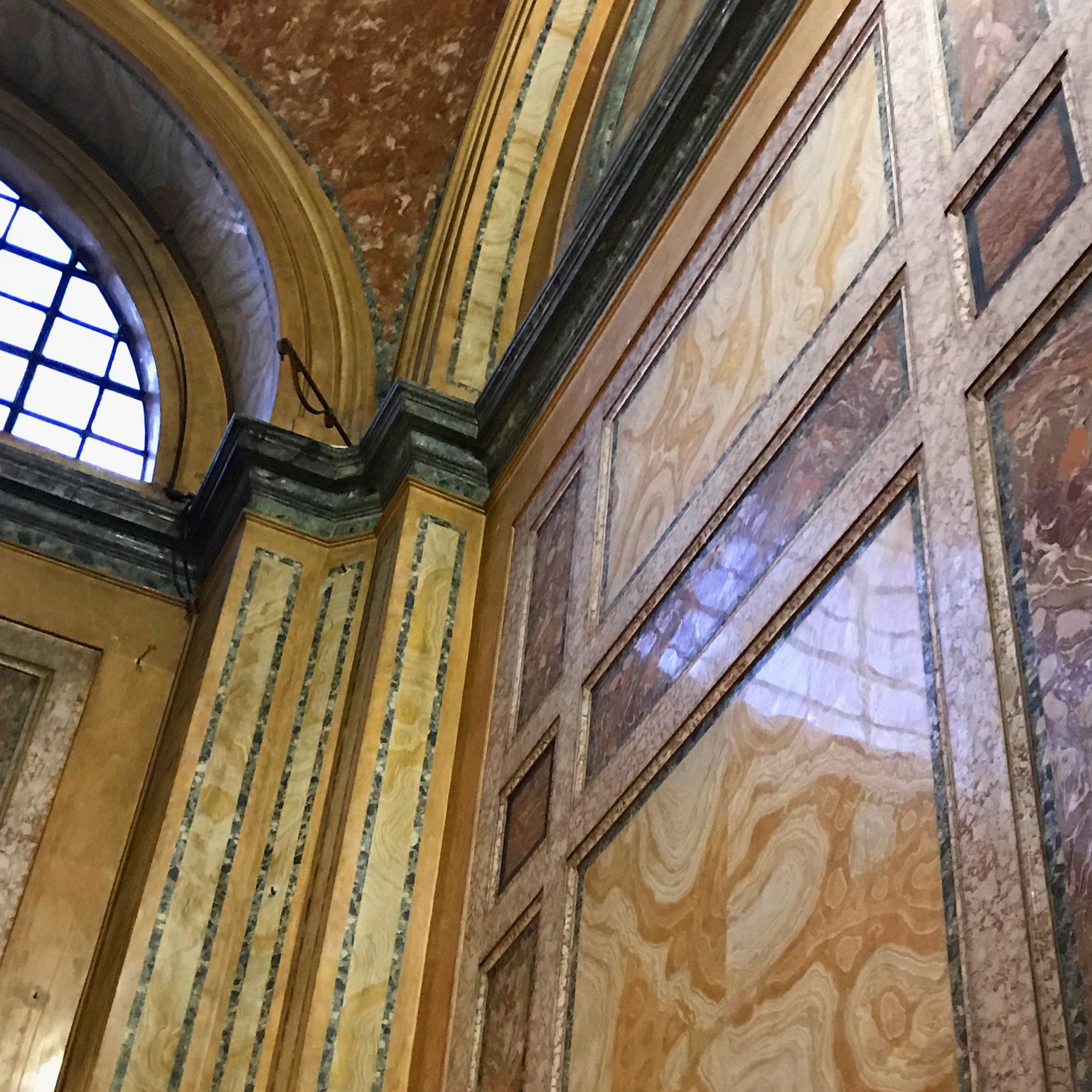
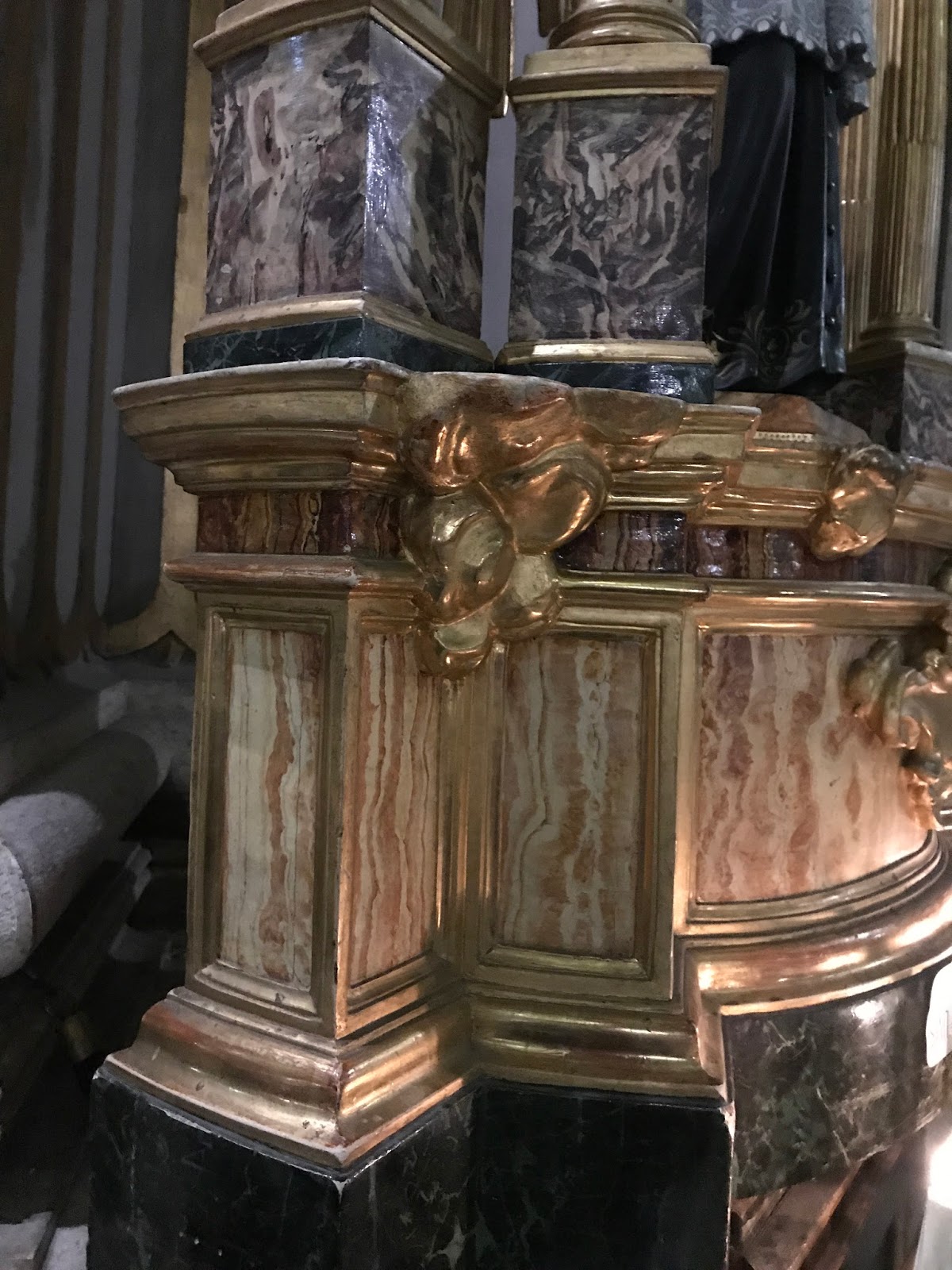
On a tip from Walter Cipriani Roma based scagliola Artist, we headed to The Sant'Andrea della Valle basilica which was designed by Giacomo Della Porta between 1590 and 1650. Once there we found a chapel that was made entirely of Scagliola. The craftsmanship was remarkable and these pictures do it no justice, but I am happy to share therm with you.
Friday, December 1, 2017
Report from Rome, scagliola doorways
While on this research trip to Italy, I have encountered many examples of scagliola produced between the 16th - 18th centuries. I was really not prepared to see this work and it really swept me off my feet. The first encounter was as surprise, at the National Roman Museum - Palazzo Altemps. The seat of the National Roman Museum at Palazzo Altemps houses important collections of antiquities consisting of Greek and Roman sculptures that in the 16th and 17th centuries belonged to various families of the Roman nobility. The scagliola was located on three of thew many doorways in the Palace, most were either painted to look like marble, or actual marble.
A truly fantastic example. this was also my first experience with the Italian style of painting marble. I became very interested in this. here is the painted doorway that was to mimic the scagliola. the painting style is much more impressionistic, and according to scagliola artist Walter Cipriani, the Italian way to paint marble is to channel the feeling of the marble, not to directly copy it.
Around a corner was the second example of a scagliola doorway, each example seem to be made by different artist. 
This example was much more erratic and wild. Finally this gentle work:
Sunday, November 12, 2017
Stills from Scagliola process coming out soon!

The plastering technique known as scagliola was developed in the Italian Baroque period and is made from a careful mixture of natural materials including gypsum, lime and raw pigments. A special "mother glue” and Bees wax is added to create the intense colors and patterns that mimic the look and complexities of marble, semi-precious stones, mosaics and inlaid stone. The process is laborious, complicated and stunning when complete. The unwritten and secretive technique is taught from master craftsman to student via workshops and apprenticeships, and this is how I learned the process. I have taken this traditionally decorative technique and transformed it into an artistic process that adds the sculptural to my previously two dimensional work.
Stills from a little video of process coming out soon!
Tuesday, October 31, 2017
Saturday, April 2, 2016
Foot fetish, you tube fetish videos as contemporary art forms and places for discussion.
Conversation between Melissa Vogley Woods and Curator of the Wexner Center film and Video Studio Program, Jennifer Lange on the work “Boxed”
JL: This isn’t the first time you’ve inserted yourself (quite physically) into a museum space. What was the starting point for this series and how has it evolved?
MVW: True! I began this series in 2013 while working on an exhibition at the Weston Art Gallery in Cincinnati. It was a large solo exhibition that took place in a towering 3-story atrium. The enormity of the space dominated everything I made and the challenge of grappling with the size propelled my interest in using the space itself in my work.
I had a preoccupation with YouTube videos that focused on movement, dance and, in particular, foot fetish channels. I saw these videos as a kind of revolt and act of claiming space and voice. I had created the video series Monochrome Suite as a feminist response to the role of the female body in the history of painting. This was the first use of the foot fetish video format. Monochrome Suite also specifically responded to the work of artist Yves Klein who used naked female bodies as “living paintbrushes” by dipping the woman into blue paint and having them roll around on canvas. It was in this series of videos that began to use this specific color blue. That color has evolved away from a direct reference to Klein and now operates as an antithetical force to the body/author.
After Monochrome Suite and in the presence of the dominant stature of the gallery space, I had a eureka moment. I conflated the foot fetish video with the challenge of the gallery. I saw an opportunity to shift the power dynamic and monumentality of the space away from the institution and towards the female body and author. I needed a miniature to-scale model of the gallery and I decided it had to be a perfect recreation to really play with scale and presence. The gallery would then be mine to toy with and, from there, I created three videos entitled Polychrome Suite.

Monochrome Suite
Polychrome Suite
I came to video originally by looking at other artists whose practices included both making objects and performing with their bodies. The work produced for the exhibition at the Weston (Monochrome Suite) was partly influenced by the artists Lynda Benglis and Cheryl Donegan, who both created videos alongside abstract painting-based works. They used themselves as subjects in sexually charged performances to create feminist commentary. The legacy of these artists play an important role in these two works, which were the departure point for the Wexner videos.
JL: Can you elaborate a bit more on the foot fetish videos? It’s an unexpected reference point (for those of us who don’t have that particular fetish) but one that connects in really interesting ways to the other ideas that more clearly influence your work like gender/sexual politics, feminist art, and performance.
MVW: There are so many things I find important about the fetish videos. Primarily I am attracted to them as a form of physical expression that avoids sexual biology. My work addresses the female body and the history of its representation but without any specific biological reference. By using just the foot, there is a removal from whole and a break from the confines of female biology. For me, the foot represents the body—the part fully expresses the whole. Yvonne Rainer’s video Hand Movie (1966) comes to mind as an example of this. There is also a level of anonymity at play in this dissection and I see a certain power in that.
The popularity of fetish videos is really due to their accessibility on YouTube and I find it interesting to consider how this democratizing network of distribution mirrors the rise of video art. Video was a medium that artists could use to create new forms and reach new audiences. And because it wasn’t a mainstream art form distributed through mainstream channels, artists and performers, particularly women, developed revolutionary practices that reverberate today. I see the same possibility with YouTube. There is an openness in new mediums and platforms. They are not yet canonized and they are available to voices that are locked out by institutional curation and mediation of those in power. This is what attracted me to work in video. I studied for several years under Wendy Geller in early 1990s and never took to it wholly until I found the foot fetish video form. The lack of narrative and abstract qualities are what attracted me to them even further.
JL: You mention Yves Klein and your use of his International Klein Blue paint color. Can you talk a bit more about painting as a medium and also the history of painting and how they inform your practice?
MVW: My work has always had a connection to painting. It has been the meat of my work even when the materials used were quite different. Painting as a discipline, painting as an event, painting as a material are all ideas I have explored. I’m also interested in paint as a facade or a fake version of something real, like the body.
Once my work became about the female body and feminist discourse, I focused more on painting’s troublesome history with the female body. The Guerrilla Girls said it best: “Do woman have to be naked to get in the Met. Museum”? But they aren’t the only ones dealing with this issue. There’s Micol Hebron, whose amazing Gallery Tally Project showed that roughly 70% of artist represent by galleries are male. Works like these reveal there is still a great lack of representation in the art world. We objectify women in part because of the prominence of the art historical canon, which continues to drive mainstream institutions. Painting has historically depicted women as silent, passive objects for your viewing pleasure and accepting that as “canon” facilitates the narrative of male power and dominance. My interest is to change the author and appropriate movement and sexual performance to create agency and to speak back to this history. It is a response from the model/object as author/subject.
JL: When you sent me a clip of your foot coming out of the Box earlier this week, I started imagining how people will encounter the work. The image is so unsettling because you do such an amazing job of recreating the Wexner Center but then there’s this giant foot in the middle of it like Alice in Wonderland or maybe Godzilla! The architecture here is a bit cold and rigid and you’ve created this amazing contrast with the explosion of flesh pouring out of the space. It totally highlights the awkwardness and confining nature of the building.
MVW: Dubbed “the Museum that Theory Build” by critic Paul Goldberger, Peter Eisenman’s Wexner Center could not have been a more perfect institution for my work. It has a cold analytical and refined feel that was a great contrast to the fleshy body and messy paint. I was particularly attracted to the 540 foot long scaffold structure that is a distinct feature on the exterior and one that is predominant on most images of the building. I couldn’t wait to mess with its rigidness. I felt it was also important to include a set build of The Box itself as an entity within the institution and to bring the viewer closer to the work, placing them within it.
I imagine people walking out of the Box, looking to find the exact perspective of the camera to imagine the foot as an enormous model. They whole scenario is quite exciting for me and I can’t wait to see what people do. I am interested to see how the viewer will be implicated. I wonder how the memory of the work will infect their memory of the space or institution as a massive structure. The fluctuation between fake and real is another interesting parallel for me in the work and one the viewer will navigate viscerally.
JL: I can’t help but think of Andrea Fraser’s Little Frank and His Carp (2001), you know the one where she’s getting visibly aroused by the “sensual curves” of another famous building, Frank Gehry’s Guggenheim Bilbao, while listening to their architectural tour? At the heart of Fraser’s work are these ideas of institutional critique and I definitely see that playing out in this series as well. Can you talk about this?
MVW: Yes, and you are so on point with the Fraser comparison. I am a fan! I see striking similarities in the use of sexual performance as a rebellion against institution, the use of architecture to represent institution, and a focus on criticism of the art world. I also use the actual institution as a dominant presence in the work itself and as metaphor for systems of power. Similarly, we both deal with the challenges of using our bodies for sexual performance as woman artists. Criticisms have ranged from being self-sabotaging, not feminist, not angry enough, objectifying the self, or using sex to sell. It is a difficult place to navigate but I find agency in repeating sexualized gestures to reclaim those expressions as feminist.
![]() |
Andrea Fraser’s Little Frank and His Carp (2001) |
JL: I’ve been so pre-occupied with the amazing images that I forgot to ask about music!! And now you’re editing in the other room and I’m hearing all these great jazzy horns and this very distinctive rhythm that reminds me of striptease performances. I know you used “stripper music” (for lack of a better description) in this series before and to great effect because it so explicitly foregrounds the sexual aspect of the work and is another point of contrast to the rigidity of the architecture and the “institution”. How much will you use this time around? Are there any other sonic or musical elements that you’re playing around with this time?
MVW: Stripper music is exactly what it is! It insists sexual performance and I like this as a counter to institution and as a strategy to leverage and mess with stereotypes. Additionally, it is specifically designed for the performing body and has a slow, measured quality that attracts me. The series of videos in The Box will explore sound in a few different ways; one work will feature a striptease soundtrack, another is highlighted by the actual sounds of the body against the model of the building, and another will have a violin accompaniment that highlights specific gestures.
JL: There’s been a lot of growth in Columbus’ art scene over the past 15 years (that’s how long I’ve lived here). You grew up here so those changes must be all the more palpable! What appeals to you most about being an artist in Columbus right now?
MVW: Yes, I have been here for 25 years now, working as an artist after doing undergrad in Kansas City. Of course there’s the Wexner Center! “Well, we have the Wexner Center!” was always a bragging right when talking to out-of-towners about the art environment of Columbus. Outside of the Wex, the signs on the doors may have changed but there has always been pretty good support for artists. This is a particularly good time in Columbus with amazing collectives both new and established such as MINT, Skylab, No Place, and CORP, as well as Beeler Gallery and Angela Meleca Gallery who are bring cutting edge work to view in their downtown spaces. Roy G Biv continues to be a bright light, as always. I feel the art scene here is on an uptick with all these new developments and, with the proper support, this will continue and flourish. It is the existence of alternative spaces and galleries who support cutting edge art practices as well as great art criticism that will make Columbus an exciting place to be an artists in the years to come.
Friday, October 2, 2015
Tuesday, March 3, 2015
Subscribe to:
Posts (Atom)